National Lifeguard
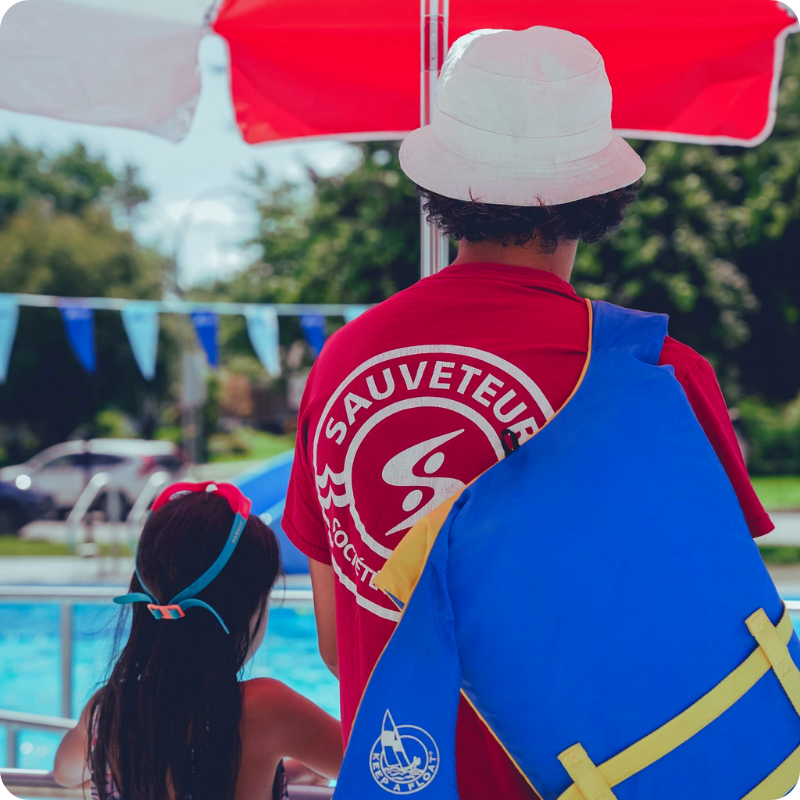
The National Lifeguard (NL) certification is Canada's recognized standard for aquatic supervision and lifesaving. Recognized across Canada, it prepares participants to work as lifeguards in various aquatic environments.
The course provides an in-depth understanding of prevention and supervision principles, strengthens judgment and decision-making skills, and develops the techniques needed to respond effectively to emergency situations.
Four options allow participants to specialize according to their aquatic environment: Pool, Waterpark, Waterfront, and Surf.
Duration
National Lifeguard – Pool: 40 hours, excluding the final evaluation
Other options: 20 hours, provided the candidate already holds a National Lifeguard – Pool certification and meets the prerequisites for the selected option
Prerequisites
To enrol in the course, candidates must:
Be at least 15 years old at the time of the final evaluation
Hold a Bronze Cross certification
Hold a Lifesaving Society Standard First Aid/AED or Aquatic Emergency Care/AED certification
For the Waterpark option: hold a National Lifeguard – Pool certification
For the Surf option: hold a National Lifeguard – Waterfront certification
Employment Opportunities
The National Lifeguard certification allows individuals to work as lifeguards starting at age 16, depending on the option held and the applicable requirements of the aquatic facility.
Certification Validity
The certification is valid for 2 years when used as a qualification for employment.
To continue performing the duties associated with the certification, lifeguards must successfully complete a recertification before it expires.
Four Specialization Options
The National Lifeguard certification is offered in four options to prepare lifeguards for the specific conditions and challenges of different aquatic environments. Each option develops supervision, prevention, and emergency response techniques adapted to the environment in which lifeguards will work.
The National Lifeguard – Pool option prepares participants to supervise and respond to emergencies in swimming pools and other aquatic facilities where this certification applies.
The course focuses on supervision, incident prevention, recognizing swimmers in distress, teamwork, and emergency response techniques specific to pool environments.
Waterparks present unique challenges due to the variety of attractions, high visitor volumes, water movement, and the specific characteristics of each facility.
The National Lifeguard – Waterpark option prepares participants to adapt their supervision and emergency response techniques to these complex and dynamic environments.
The National Lifeguard – Waterfront option prepares participants to supervise swimming areas located in lakes, rivers, and other inland bodies of water.
Participants learn to consider the unique characteristics of natural aquatic environments, such as currents, varying water depths, underwater visibility, weather conditions, and bottom conditions. The course also introduces various rescue equipment suited to these environments.
The National Lifeguard – Surf option prepares participants to supervise and perform rescues in marine environments where conditions can be particularly challenging.
The course develops the skills needed to assess waves, tides, currents, varying water depths, and other hazards specific to ocean environments. Physical requirements are also adapted to the challenges presented by these conditions.
Re-examination After an Unsuccessful Evaluation
Candidates who do not pass the initial evaluation for certain National Lifeguard options may be eligible to take a re-examination without repeating the entire course, provided they meet the eligibility requirements.
However, the re-examination is not limited to the items previously failed. All components of the National Lifeguard evaluation are reassessed, including theoretical knowledge, physical requirements, and rescue situations.
Candidates must:
Complete the re-examination within one year of failing the course
Hold all required prerequisite certifications
Provide the unsuccessful evaluation report and any requested documents
Obtain authorization from the Lifesaving Society before participating in the re-examination
A maximum of three re-examination attempts is permitted. After a third unsuccessful attempt, candidates must repeat the National Lifeguard course before attempting to obtain the certification again.
Candidates are encouraged to review and practise all course components, particularly those they did not successfully complete during their previous evaluation..
Once eligibility has been confirmed by the Lifesaving Society, candidates may look for a National Lifeguard course or recertification session in which to complete their re-examination.
The organization responsible for the session must be contacted before registration to confirm that it can accommodate the re-examination and allocate sufficient time for the complete evaluation.
Once the date and location have been determined, the information must be submitted to the Lifesaving Society for final approval.