Swim to survive +
It is essential for young people to develop safe behaviours in an environment like ours, where rivers and lakes are so common. How should they respond when someone is in distress? Rather than lecturing, the Lifesaving Society’s Swim to Survive+ program gets young teens moving, thinking, and taking action.
Swim to Survive+ can be incorporated into regular physical education classes, as the teacher can actively participate in delivering the program.
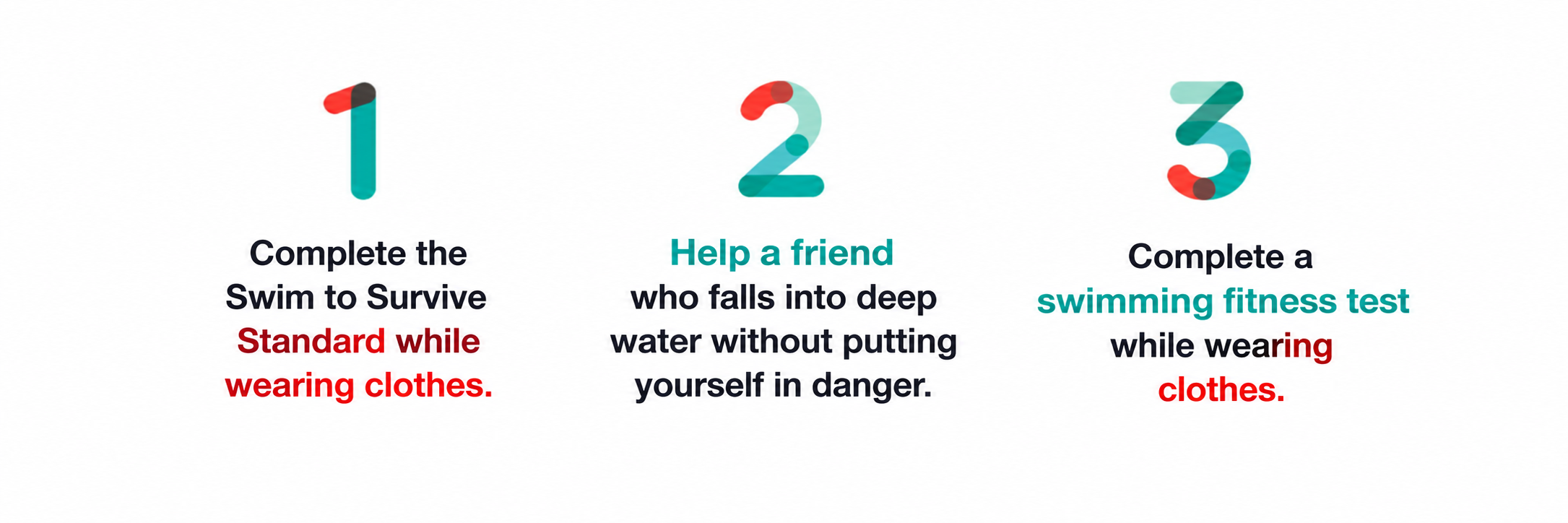
The Canadian Swim to Survive Standard goes one step further! The “+” means that the three basic skills—roll entry, treading water, and swimming 50 metres—are performed in a more realistic setting: while wearing clothes. After all, people are rarely wearing a swimsuit when they unexpectedly fall into deep water!
In addition to learning new self-rescue techniques, the Lifesaving Society’s program teaches Secondary 1 and 2 students how to safely help a friend in distress.
Swim to Survive+ also introduces students to basic physical fitness concepts through interval training and swimming.
Note
Participation in the Swim to Survive program for students aged 8 and older (elementary schools) is not required.
Recommended clothing for the Swim to Survive+ program includes long pants and a short- or long-sleeved shirt.
Swim to Survive+ can be adapted to students with different swimming abilities, making it an excellent introduction for beginners.
Theory Topics
Students will be able to:
svg Recognize the signs of a person in distress as well as changing environmental conditions;
svg Analyze and assess how to respond;
svg Take action by following the first steps of the Ladder Approach.
Students will be able to:
svg Learn what to do if they find themselves alone in a dangerous situation with nothing to hold onto. The pool provides a safe environment in which students can experience the resistance created by clothing in the water and even learn how to turn their clothes into flotation aids.
You’ve probably already heard plenty of warnings about drugs—their effects and their consequences. Just remember this: one drink on the water is like three on land!
Students will be able to:
svg Understand the seriousness of the early signs of hypothermia and respond appropriately by using the recommended techniques.
Don’t swim after eating; don’t hold your breath underwater; a drowning person surfaces three times before drowning… Are these facts, or just aquatic myths?
Students will learn to recognize:
svg Where, when, and how to safely enjoy activities on a frozen lake;
svg Who to go with and what equipment to bring.
The program is intended for Secondary 1 and 2 students whose school is located in Quebec. If the school does not have a pool, a partnership can be established with an aquatic centre or another facility with access to a pool.
Financial assistance of up to $25 per student is available to cover transportation costs, pool rental, and lifeguard wages.
Physical education teachers can incorporate the theoretical and practical components of Swim to Survive+ into their regular classes. The theory component can cover all topics or a minimum of four topics selected according to students’ interests, the local environment, the season, or other relevant factors.
These topics may be presented before or during the pool sessions. A minimum of five hours of in-water activities is required, although the activities may be combined or extended as needed.
Participation Conditions
After consulting with colleagues, a staff member from the school—often, but not necessarily, a physical education teacher—contacts the aquatic facility manager to coordinate the pool component of the program. This person is responsible for the student group during the practical sessions, including supervision and guidance.
The physical education teacher can incorporate the theoretical and practical content of Swim to Survive+ into regular classes and participate in delivering, supervising, and overseeing the activities.
The aquatic facility manager assists in finding qualified staff and ensures compliance with the requirements of the